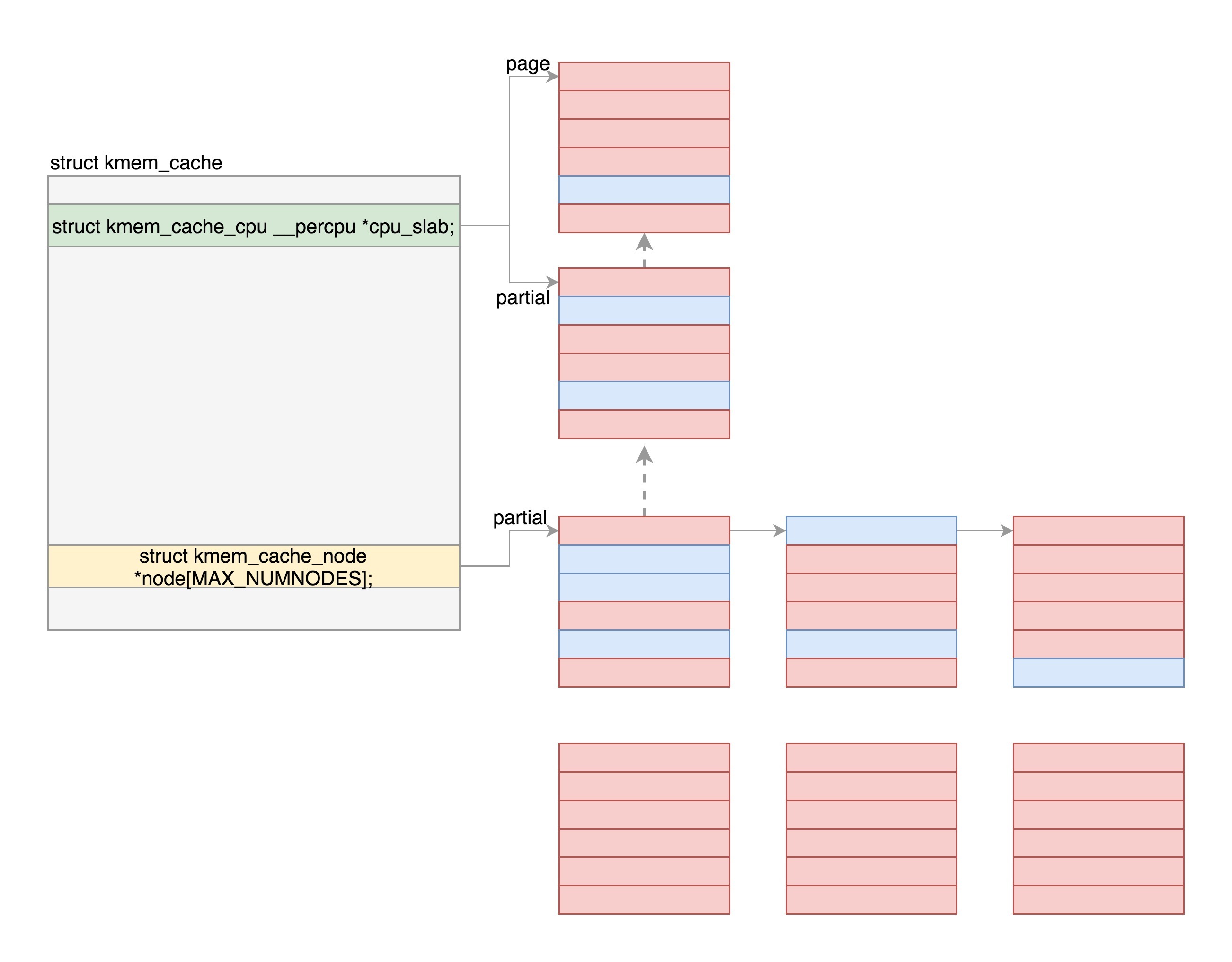
struct kmem_cache {
	struct kmem_cache_cpu __percpu *cpu_slab;
	/* Used for retriving partial slabs etc */
	unsigned long flags;
	unsigned long min_partial;
	int size;		/* The size of an object including meta data */
	int object_size;	/* The size of an object without meta data */
	int offset;		/* Free pointer offset. */
#ifdef CONFIG_SLUB_CPU_PARTIAL
	int cpu_partial;	/* Number of per cpu partial objects to keep around */
#endif
	struct kmem_cache_order_objects oo;
	/* Allocation and freeing of slabs */
	struct kmem_cache_order_objects max;
	struct kmem_cache_order_objects min;
	gfp_t allocflags;	/* gfp flags to use on each alloc */
	int refcount;		/* Refcount for slab cache destroy */
	void (*ctor)(void *);
......
	const char *name;	/* Name (only for display!) */
	struct list_head list;	/* List of slab caches */
......
	struct kmem_cache_node *node[MAX_NUMNODES];
};
struct kmem_cache_cpu {
	void **freelist;	/* Pointer to next available object */
	unsigned long tid;	/* Globally unique transaction id */
	struct page *page;	/* The slab from which we are allocating */
#ifdef CONFIG_SLUB_CPU_PARTIAL
	struct page *partial;	/* Partially allocated frozen slabs */
#endif
......
};
/*
 * Inlined fastpath so that allocation functions (kmalloc, kmem_cache_alloc)
 * have the fastpath folded into their functions. So no function call
 * overhead for requests that can be satisfied on the fastpath.
 *
 * The fastpath works by first checking if the lockless freelist can be used.
 * If not then __slab_alloc is called for slow processing.
 *
 * Otherwise we can simply pick the next object from the lockless free list.
 */
static __always_inline void *slab_alloc_node(struct kmem_cache *s,
		gfp_t gfpflags, int node, unsigned long addr)
{
	void *object;
	struct kmem_cache_cpu *c;
	struct page *page;
	unsigned long tid;
......
	tid = this_cpu_read(s->cpu_slab->tid);
	c = raw_cpu_ptr(s->cpu_slab);
......
	object = c->freelist;
	page = c->page;
	if (unlikely(!object || !node_match(page, node))) {
		object = __slab_alloc(s, gfpflags, node, addr, c);
		stat(s, ALLOC_SLOWPATH);
	}
......
	return object;
}
static void *___slab_alloc(struct kmem_cache *s, gfp_t gfpflags, int node, unsigned long addr, struct kmem_cache_cpu *c) { void *freelist; struct page *page; ...... redo: ...... /* must check again c->freelist in case of cpu migration or IRQ */ freelist = c->freelist; if (freelist) goto load_freelist;
/* * The background pageout daemon, started as a kernel thread * from the init process. * * This basically trickles out pages so that we have _some_ * free memory available even if there is no other activity * that frees anything up. This is needed for things like routing * etc, where we otherwise might have all activity going on in * asynchronous contexts that cannot page things out. * * If there are applications that are active memory-allocators * (most normal use), this basically shouldn't matter. */ static int kswapd(void *p) { unsigned int alloc_order, reclaim_order; unsigned int classzone_idx = MAX_NR_ZONES - 1; pg_data_t *pgdat = (pg_data_t*)p; struct task_struct *tsk = current;
/* * This is a basic per-node page freer. Used by both kswapd and direct reclaim. */ static void shrink_node_memcg(struct pglist_data *pgdat, struct mem_cgroup *memcg, struct scan_control *sc, unsigned long *lru_pages) { ...... unsigned long nr[NR_LRU_LISTS]; enum lru_list lru; ...... while (nr[LRU_INACTIVE_ANON] || nr[LRU_ACTIVE_FILE] || nr[LRU_INACTIVE_FILE]) { unsigned long nr_anon, nr_file, percentage; unsigned long nr_scanned;